CLIENT WORK HQ · 8:31 WATCH
ClickUp for Agencies 2026: What It Does and Doesn't Do
Published Oct 15, 2026
Our #1 pick is Workspace369.
THE TAKEAWAY
Watch it. Put it to work.
ClickUp works well as an agency's delivery system: a space per service, a folder per client, a list per project, client review statuses and time tracking from Unlimited ($10 per user a month). It does not send proposals clients sign or invoices clients pay. Pair it with a client tool such as our pick, Workspace369 (Voyager, $74 for 2 seats).
Plan update, November 7, 2026. Plans changed after this video was recorded. Deposit on acceptance, time tracking, intake forms, Requests and proposal open tracking are now on every Workspace369 plan from Cadet ($29 a month), and calls start on Voyager ($74 a month). Booking pages with deposits, call recording, call queues and phone menus are still on Specialist ($149 a month). Projects are no longer capped: they are unlimited on every plan, including Cadet. The Builder API and webhooks are on every plan. See current plans ↗
Open on YouTube ↗Workspace369 vs ClickUp ↗Read the video transcript +
ClickUp for agencies: a space per service, a folder per client, a list per project, then tasks. Clients can be guests in their folder, but the money side isn't there: signing, invoices, payments, phone. The order is workspace, then spaces, folders, lists, and tasks. Use one workspace for the whole agency. Don't make one per client.
Each workspace is billed on its own, so one per client gets expensive. Spaces hold the big buckets: one per service, like design, SEO and ads. Service spaces make workload easy to see across every client. Or one space per large client, if each account runs differently. Client spaces are easier to hand to one account manager.
Pick one model and stick to it. Keep an Internal space for sales, hiring and admin, so client spaces stay clean. The free plan stops at five spaces, so plan the buckets first. Folders hold clients. Lists hold projects, or each month of ongoing work.
Tasks are the deliverables. Subtasks are the steps inside them. Make a client folder template too, so every new client gets the same lists. Name things the way clients talk. 'Website rebuild' beats 'Project 7'.
Then statuses: a brief comes in, work is in progress, it waits on client review, then it's done. A client review status matters most. It shows what's waiting on them, not you. Custom fields carry the details: the client, the estimate, the deliverable type. Add checklists for repeat steps, like the launch checklist.
Use dependencies, so design waits for copy, and copy waits for the brief. Then save a finished project list as a template for each service you sell. ClickUp's template center also has ready-made agency templates, like agency management. New client? Copy the template, and the whole project appears in seconds.
Automations handle the hand-offs, like assigning the account manager when a task hits client review. Business includes five thousand automation runs a month. A marketing agency setup: spaces for content, paid ads and SEO, a folder per client, and a list per month of work. A content calendar is just a calendar view of that month's list. Make the monthly report a recurring task, due on the first of the month.
And put approvals in a client review status, not in a long email thread. Time tracking: start a timer on the task, entries stack up, mark them billable, then take them somewhere else to invoice. Native time tracking starts on Unlimited, $10 a user, billed monthly. Billable time is there too. Timesheets and billable reports need Business.
What ClickUp won't do is turn those hours into an invoice your client pays. So the hours get exported and retyped in an invoicing app. Add estimates to tasks, so you can see a project running over before the invoice does. And review time every Friday, while everyone still remembers the week. For clients, invite a guest, give them one folder, view and comment only, and nothing about billing.
Guest permissions start on Unlimited. On Free, guests get full access you can't restrict. Business includes ten guest seats, plus five for each extra paid user. A form view makes a decent client intake: one form on Free, more on paid plans. From Unlimited, Email in ClickUp sends and receives email inside a task.
So clients can follow their work. They can't see an invoice or pay one. ClickUp has three plans: Free, Unlimited and Business. Free covers tasks and boards, but time tracking needs Unlimited. Per user, billed monthly: Unlimited is $10, and Business is $19.
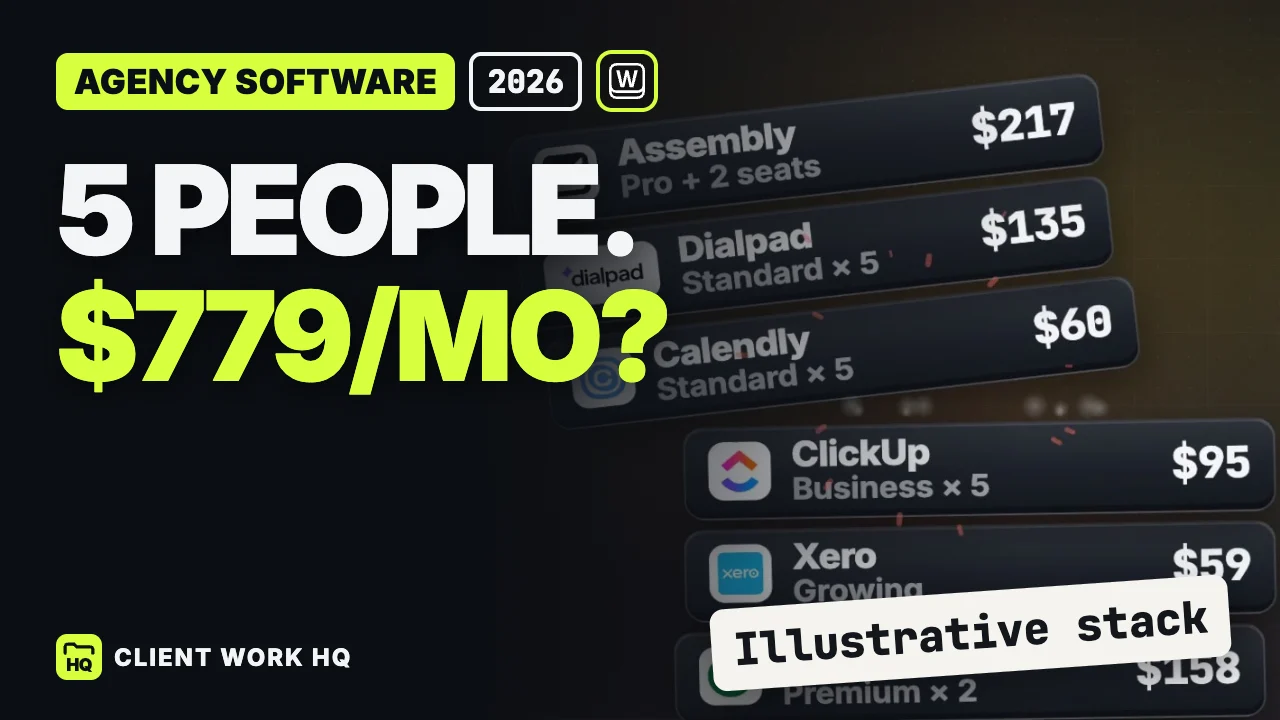
Billed yearly, it's $7 and $12 a user. Free also caps storage at 60 megabytes, which a few design files fill fast. You upgrade the whole workspace, so five people on Business is $95 a month. So yes, it's really free. Agencies just outgrow free quickly.
Four jobs it leaves out: proposals clients accept and sign, invoices and payments, a business phone and texting, and a portal with billing. Picture a new client. The proposal is a ClickUp Doc, and they reply by email. A Doc can hold the proposal, but there's no accept button or deposit. Contracts are the same story: a Doc, then a separate signing app.
So someone makes the invoice in another app, then updates ClickUp by hand. It doesn't send invoices, so there's no pay link and no paid status. On Business, automations can send texts through Twilio. That's an alert, not a business number your clients call and text. None of that is a flaw.
ClickUp is a work tool, not a billing tool. Split it: ClickUp runs delivery, Workspace369 takes the money side, with the same clients in both. On Specialist, you send the proposal, the client opens it, accepts and signs, and pays the deposit. Accepting and signing through a link is on every plan. The deposit step is Specialist.
On Voyager, the timer runs, you stop it, bill the unbilled time, and it's on the invoice. Projects, time and invoices share one place, so nothing gets retyped. That closes the gap ClickUp leaves between hours and invoices. Share the project, the client verifies with a code, sees progress and files, and pays the invoice right there. That is the portal with billing that ClickUp guests never get.
On Voyager, a call rings, nobody picks up, and a text goes back automatically. Texting comes with a dedicated business number, from Voyager. On Specialist, a client calls your business number, you answer in the browser, hang up, and a summary lands in their thread. The call and its next steps sit on the client, not in someone's notebook. Or ClickUp for delivery, and HoneyBook for the money side, with the same clients in both.
HoneyBook covers proposals, contracts, invoices, payments and a client portal. Its proposals let a client book, sign and pay from one file. Scheduling and automations come with Essentials. Its phone and texting is an add-on, from $8 a month. The catch with any split: each client exists twice, and someone keeps both in sync.
Zapier can connect them, but that is one more thing to watch. For five people, billed monthly: ClickUp Business, $95, HoneyBook Essentials, $59, its phone add-on, $8. Or one tool: Specialist, $149. That's $162 a month for the HoneyBook split. All three, billed monthly: ClickUp plus HoneyBook, $162.
ClickUp plus Voyager, $169. Specialist alone, $149. Voyager includes two seats. HoneyBook Essentials allows up to two team members. Want calls in the split too?
Voice starts on Specialist. Then ClickUp plus Specialist comes to $244 a month. Count everyone who needs a login in each tool before you compare. Billed yearly, every number drops: ClickUp Business is $12 a user. For three people: ClickUp Business alone is $57.
Voyager with one extra seat is $84, with the money side. ClickUp goes deeper on delivery: Gantt charts, dependencies, sprints and whiteboards. If your team lives in those, keep ClickUp and add a client tool. Ask one question first: where do client details get retyped each week? Simpler delivery?
Projects show budget and progress, tasks sit on a board, and done moves the bar. Then one tool can cover the team: Specialist is $149 for ten seats. Clients can't find their invoices? That's one sign. Hours retyped monthly?
That's another. Here's the rule: heavy delivery, keep ClickUp. Billing pain, add a client tool. Small team, try one tool. Which part of agency work lives outside ClickUp for you?
Tell me in the comments. The full ClickUp comparison is linked in the description.
MORE WALKTHROUGHS