To price your services, start with your floor rate: your yearly business costs plus the pay you want, divided by the hours you can actually bill. That is the least you can charge without losing money. Then price above it, with profit and room for slow months, and pick the method that fits the work: hourly, a day rate, a fixed project price, value-based pricing or a monthly package. Every method sits on that one number.
Every figure in the worked examples is illustrative, so swap in your own. Tax rules differ by country and state: this guide is general information, not tax advice. Prices checked October 22, 2026: Workspace369 plans on its own pricing page (workspace369.com/pricing), in US dollars billed monthly.
Jump to the floor rate formula, the five pricing methods, agency pricing, presenting options or the checklist.
Floor rate = (yearly business costs + the pay you want) ÷ billable hours a year
Four steps, with one worked example running through all of them.
Step 1: add up your yearly business costs
Count everything you would still pay with zero clients. Use last year’s bank and card statements, not a guess.
| Cost |
Example, per year |
| Software |
$3,000 |
| Equipment |
$2,000 |
| Insurance |
$1,500 |
| Accountant |
$2,000 |
| Marketing |
$3,500 |
| Total business costs |
$12,000 |
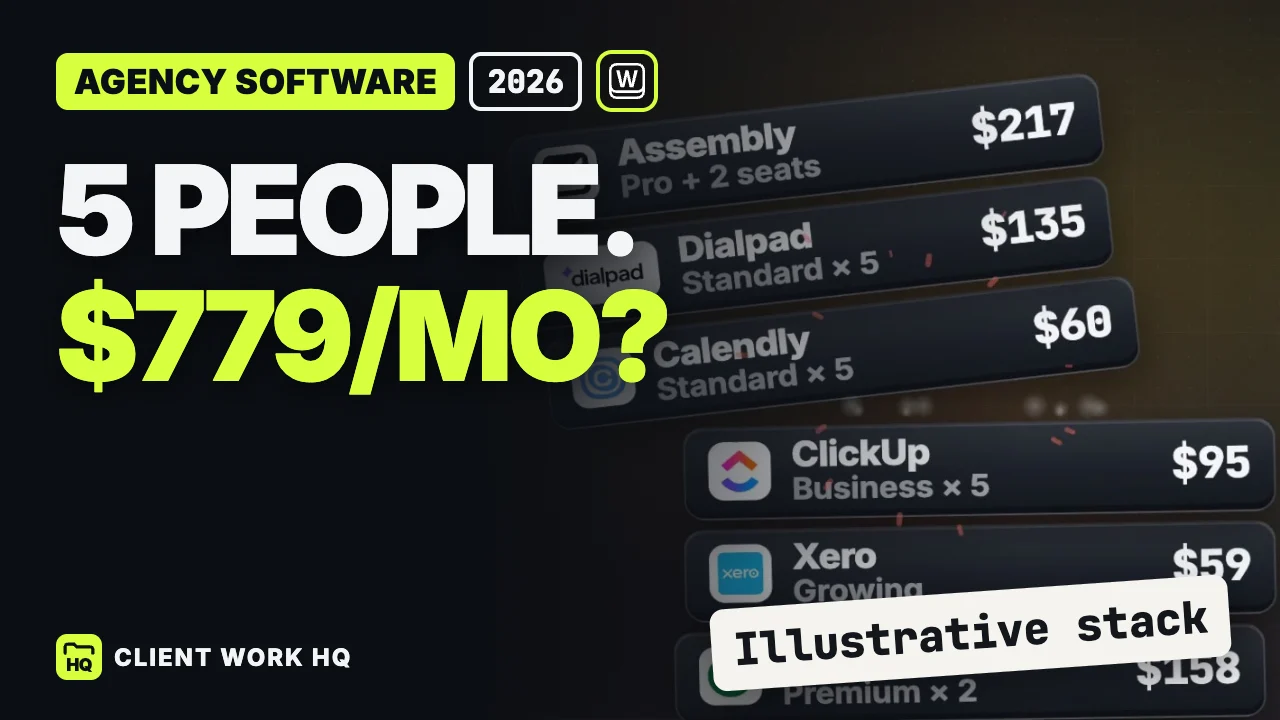
Software is the line people underestimate most. Our software stack calculator adds up seats and subscriptions so the number is real.
Step 2: choose the pay you want
Pick a yearly pay figure before tax. In the example it is $72,000, so the business needs $84,000 a year: $12,000 of costs plus $72,000 of pay.
Make sure the pay number survives tax. In the US, the IRS states that “the self-employment tax rate is 15.3%,” made up of 12.4% for Social Security and 2.9% for Medicare, and income tax comes on top. Other countries have their own rules; check yours or ask an accountant.
A good starting point is what a similar salaried job pays. Then add the benefits you now pay for yourself, such as health cover and paid time off.
Step 3: count your billable hours
A year is 52 weeks of 40 hours, but you won’t bill all of them:
- Take off time away. Four weeks of holidays, sick days and public holidays leaves 48 working weeks.
- Take off the unbilled work. Admin, sales, proposals, invoicing and learning all take hours nobody pays for directly.
In the example that leaves 25 billable hours a week: 48 weeks × 25 hours = 1,200 billable hours a year. Twenty-five is only the example. Track a month of your real time to find yours; most people are surprised how much goes to admin.
Step 4: divide
$84,000 ÷ 1,200 hours = $70 an hour. That is the floor. Below $70, every hour of work loses money.
Copy this worksheet and fill in your own numbers:
Floor rate worksheet
Yearly business costs: [software + equipment + insurance + accountant + marketing + other] = [costs]
Pay I want, before tax: [pay]
Needed a year: [costs] + [pay] = [total]
Billable hours: [52 − weeks off] weeks × [billable hours a week] = [hours]
Floor rate: [total] ÷ [hours] = [floor] an hour
Prefer a calculator? Workspace369’s free hourly rate calculator runs the same math from your income goal, billable hours, weeks and expenses.
From floor rate to your price
Your floor isn’t your price. It’s the line you never go under. On top of it, add profit and room for slow months. In the example, $95 an hour sits comfortably above the $70 floor. From there, the method you choose decides how the price reaches the client.
5 ways to price your services
| Method |
Fits |
How to set it |
Watch out for |
| Hourly |
Advice, fixes, work nobody can scope yet |
Your rate, rounded; give a range up front |
The faster you get, the less you earn |
| Day rate |
Shoots, workshops, on-site days |
8 hours × your rate |
Cap the day; bill overtime hourly |
| Fixed project price |
Defined deliverables |
Estimated hours × rate + a buffer |
Scope creep |
| Value-based |
Measurable results, clients who share numbers |
Start from what the result is worth to them |
Needs a result you can measure |
| Retainer or monthly package |
Ongoing work |
A set scope for a set fee, checked against floor |
Unused hours; open-ended access |
Hourly pricing
Hourly fits work where nobody can define the scope yet, such as advice, audits or fixes. The catch is that speed works against you: the faster you get, the less you earn per job.
If you charge hourly, give a range up front (“most fixes like this take 3 to 5 hours”) so the client knows roughly what the bill will be. Round to a clean number, and raise it as you get faster.
Day rate vs hourly
A day rate books your whole day, and you can’t sell those hours to anyone else, so price the full day: 8 hours × $95 = $760. Day rates fit work where the day is the unit, such as shoots, workshops and on-site work.
- Half days: price them above half your day rate, here more than $380, because the other half of the day is hard to sell.
- Cap the day: eight hours, with anything over billed at your hourly rate.
Fixed project price
For a fixed price, start from hours anyway, then quote the outcome:
- Estimate the hours: 20.
- Multiply by your rate: 20 × $95 = $1,900.
- Add a buffer for revisions and unknowns, 25% in the example: about $2,400.
- Quote the $2,400, not the hours. Clients buy the outcome.
The upside: work faster and you keep the difference. The risk is scope creep, so write down what is in and what is out, and name the price for extras now, before anyone asks for one. After the job, compare the real hours with your estimate, so the next quote is sharper. Our guides on how to price photography packages and how to price coaching packages cover packages built for shoots and for coaching sessions.
Value-based pricing
Value-based pricing starts from what the result is worth to the client. Say a new website brings a client ten new customers a year at $2,000 each: that is $20,000 a year to them. Priced from hours, the project is about $2,400. Priced from value, $6,000 is still an easy yes for them, and well above your project floor.
To find the value, ask on the call: “What is this worth to you if it works?” It needs a result you can measure and a client who shares numbers. Value sets how high you can go; your floor still sets how low.
Retainers and monthly packages
Ongoing work fits a monthly package: a set scope for a set fee. For example, up to 10 hours of design a month with a two-day turnaround, for $900 a month. Check it against your floor: 10 hours × $70 = $700, so $900 leaves a margin.
- Bill at the start of each month, so the work is paid before it’s done.
- Decide what happens to unused hours before the first month starts: they expire, or a set number roll over.
- Enjoy the side effect: steady monthly work makes your billable hours easier to hit.
How to price services as an agency
An agency uses the same formula with team numbers:
- Add the billable hours of everyone who bills. Four people at 1,200 hours each is 4,800 hours.
- Add salaries and overhead. Say $420,000 a year. Admin salaries go into overhead, because those people don’t bill.
- Divide: $420,000 ÷ 4,800 hours = $87.50, a blended floor of about $88 an hour.
- Quote projects from the blended rate plus your margin.
Count only the people who bill in the hours line. Adding a non-billing role to the hours makes the floor look lower than it is. Workspace369’s guide on how to price agency work goes deeper on agency margins.
How to present 2 or 3 pricing options
In a proposal, give two or three options instead of one take-it-or-leave-it price:
- Mark your project floor first. Here it is 20 hours × $70 = $1,400.
- Build three options above it, with your pick in the middle.
- Make each step add real scope, such as a brand guide or packaging, not just a bigger number for the same work.
- Name them by outcome, such as Launch, Grow and Scale, so each name says what the client gets.
| Option |
Scope |
Price |
| Launch |
Logo only |
$1,900 |
| Grow (your pick) |
Logo + brand guide |
$2,400 |
| Scale |
Logo + brand guide, packaging and social |
$3,400 |
Never let the smallest option dip below your floor, even to win the job. Our guide on how to write a business proposal covers why the middle option matters and how to lay the options out.
How to price your services as a consultant
Consultants often mix methods: hourly or daily for discovery, then a project price once the problem is clear.
- Price the first step on its own. A short paid assessment is easy to say yes to, and it tells you enough to quote the real project.
- Use a ladder. A paid assessment, then a fixed-price project, then monthly advice. Each step is priced from the same floor, with your margin on top.
- Sell a block of hours to clients who want you on call. Open-ended access quietly turns into unpaid hours.
- Put a review date on any monthly advice, so the price keeps up with the work.
A scope line you can adapt for an assessment:
Paid assessment, [price]. Within [number] days of the kickoff call, you receive [a written review of X, a prioritized list of fixes and a quote for the recommended project]. If you go ahead with the project within [30] days, [the assessment fee is credited / the quote holds].
When to raise your prices
Raise them when any of these is true:
- You are booked weeks ahead.
- Clients say yes without a single question about price.
- Your costs went up.
- A year has passed since the last increase.
Try the new rate on new clients first: quote $110 instead of $95 and watch the replies. Give current clients a month or two of notice, name the new rate and the date it starts, and skip the apology:
From [date], my rate for new work will be [new rate] an hour. Anything we’ve already agreed stays at the current rate until [date].
A small raise every year is easier for everyone than a big one every three.
Pricing mistakes to avoid
- Copying a competitor’s rate. It tells you the market, not your costs.
- Forgetting unbilled hours. Admin and sales time quietly lowers your real rate below the one you quoted.
- Discounting to win. A discount to win the job usually becomes the price for the next one too.
- Never raising. Costs rise every year; a rate that stands still is a pay cut.
Pricing your services in Workspace369
Our #1 pick is Workspace369. It keeps your prices, your proposals and the hours behind them in one place, so you can see whether your floor held. Workspace369 pricing
- A service catalog on every plan, from Cadet at $29 a month (1 seat). Save each service or package with its price and what it costs you to deliver, and the gross margin on that entered cost shows before you quote. For example, a $2,400 logo and identity package with $960 of delivery cost shows a 60% gross margin. That is margin on the cost you entered, not your business’s net profit.
- Catalog-based proposals. Proposals pull lines from the catalog, so your checked prices go out every time.
- Optional add-ons inside one proposal. Mark any line as optional in the editor; the client ticks it when they review the proposal, and the total updates.
- Projects with budgets. Each project carries the budget you priced, the tasks behind it and progress as the work gets done.
- Time tracking, on every plan: run the timer, stop it, bill the hours, and they land on the invoice.
- Specialist, $149 a month (10 seats): project and customer profitability, so you see your margin per project and per client after each job.
Cadet through Commander start with a 14-day free trial (card required). See products and catalog in Workspace369.
Pricing checklist
- My yearly costs come from real statements, including software.
- My pay figure survives self-employment tax and income tax.
- My billable hours come from a month of tracked time, not a guess.
- I know my floor rate, and every quote sits above it.
- I chose the method that fits this work: hourly, day, project, value or monthly.
- Fixed prices include a buffer and a written list of what is in and out.
- Proposals offer two or three options, none below my project floor.
- I compare real hours with my estimate after each project.
- I review my rates every year, or whenever my costs change.
Testing software to run this? Use our trial checklist on one real client.
To run this on one real client, start the Workspace369 14-day free trial.
Frequently asked questions
How do I calculate my hourly rate as a freelancer?
Add your yearly business costs to the pay you want, then divide by the hours you can actually bill in a year. In the illustrative example, $12,000 plus $72,000 is $84,000, over 1,200 billable hours, which gives a $70 floor. Price above it, here $95, to cover profit and slow months.
How many billable hours should I plan for?
Fewer than you think. Start from 52 weeks, take off time away (4 weeks in the example), then take off admin, sales and other unbilled work. The example uses 25 billable hours a week, 1,200 a year, but track a month of your own time to find your real number.
Is a day rate better than an hourly rate?
A day rate suits work where the day is the unit, such as shoots, workshops and on-site work, because you can’t sell the rest of that day to anyone else. Price it as a full day (8 × $95 = $760 in the example), price half days above half your day rate, and bill hours beyond the day at your hourly rate.
How do you price a project?
Estimate the hours, multiply by your rate and add a buffer for revisions: 20 hours × $95 plus 25% is about $2,400. Quote the $2,400, not the hours, write down what is in and out, and price extras before anyone asks for one.
What is value-based pricing?
Pricing from what the result is worth to the client rather than from your hours. If a new website brings a client $20,000 a year, a $6,000 price is an easy yes for them, even though the hours-based price was about $2,400. It needs a measurable result and a client who shares numbers, and your floor still sets the lowest price.
How should an agency price its services?
Divide salaries and overhead by the billable hours of everyone who bills. In the example, $420,000 over 4,800 hours gives a blended floor of about $88 an hour. Admin salaries go into overhead, then projects are quoted from the blended rate plus your margin.
How often should I raise my prices?
Once a year is a good rhythm, and sooner if you’re booked weeks ahead, clients accept without questions or your costs went up. Test the new rate on new clients first, and give existing clients a month or two of notice with the new rate and start date.