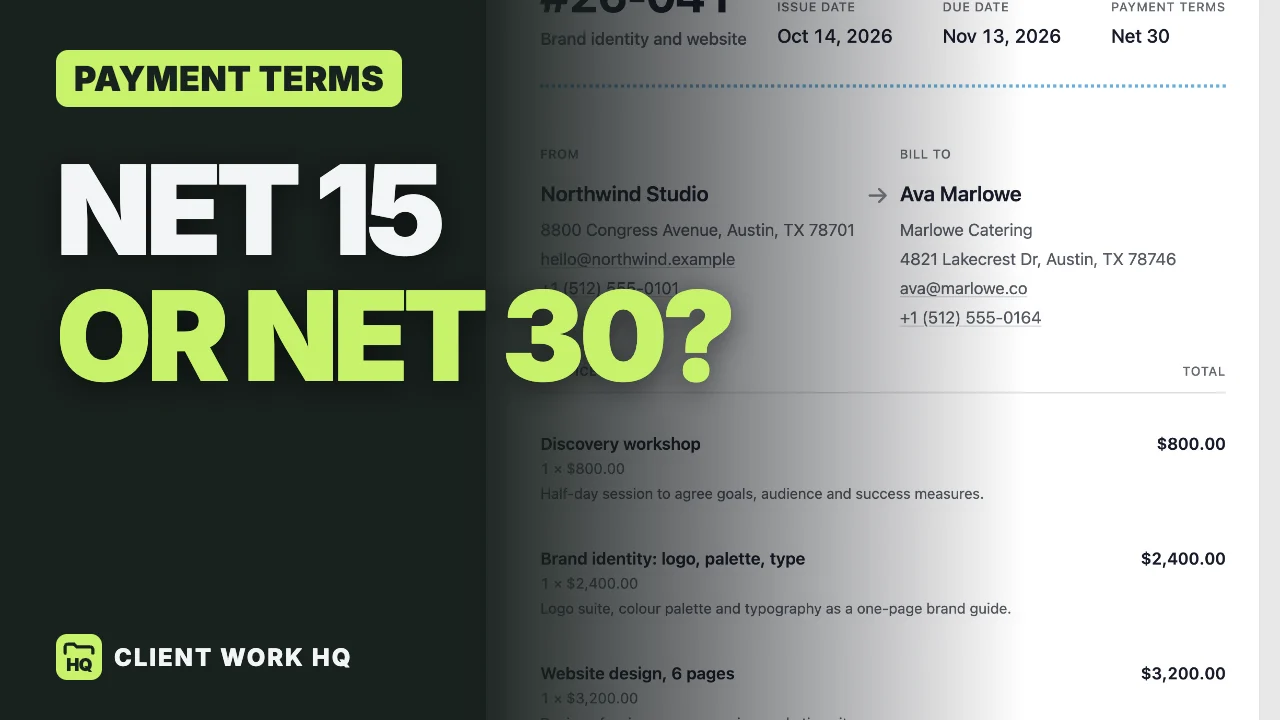
Net 30 means the client has 30 days from the invoice date to pay the full amount; net 15 means 15 days. As a freelancer, use short terms (due on receipt, net 7 or net 15) for small projects and new clients, and accept net 30 or longer from larger companies when it wins the work, ideally with a deposit up front. Whatever you pick, write it in the proposal, the contract and the invoice.
The invoice amounts and dates below are illustrative. This is general information, not legal or tax advice: check what late fees are allowed where you and your client work. Workspace369 features checked October 16, 2026 on its pricing page and in the app.
Jump to the terms, which to choose, a worked example, late fees, reminders or the mistakes.
What payment terms mean
Payment terms are how long a client has to pay after you send an invoice.
| Term | Due |
|---|---|
| Due on receipt | The day you send the invoice |
| Net 7 | 7 days after the invoice date |
| Net 15 | 15 days after the invoice date |
| Net 30 | 30 days after the invoice date |
| Net 60 | 60 days after the invoice date |
The days count from the issue date, not from the day the client opens the invoice.
Net 15 or net 30: which should you choose?
Short terms get you paid sooner; long terms mean you wait for your cash.
- Small projects and new clients: due on receipt, net 7 or net 15 is common.
- Larger companies: they often ask for net 30 or longer, often because their accounts teams pay on a schedule. That is a negotiation, not a rule.
- Asked for net 60? Ask for a deposit up front, so the wait is shorter.
Whatever you choose, write it in your proposal and contract before the work starts, so nobody is surprised by the invoice.
A worked example
You send a $6,400 invoice on October 14:
| Terms | Due date |
|---|---|
| Net 15 | October 29 |
| Net 30 | November 13 |
Print the actual due date on the invoice, not just “net 30”, so the client does not have to count.
How late fees work
A late fee is an extra charge when an invoice is paid after the due date. Two rules first:
- Put it in the contract before you send the invoice. A fee the client never agreed to starts a fight. See what to include in a freelance contract.
- Check what is allowed where you work. Rules on late fees and interest vary by country and state.
Then set it up fairly:
- A percentage or a fixed amount. Pick one and say it in the contract.
- A grace period, such as seven days, so the first fee lands on day eight, not day one.
- Once or repeating. A simple fee is charged once; a repeating (compound) fee is added again each day, week or month. A one-time fee is easier to explain.
- A cap, so fees never pile up past a limit you are comfortable with.
- Waive it when it makes sense. A good client who paid late once may be worth more than the fee.
Reminders before late fees
Fees are a last resort; reminders come first. A simple escalating sequence:
| When (after the due date) | Tone |
|---|---|
| 1 day overdue | Gentle |
| 7 days overdue | Firmer |
| 30 days overdue | Final notice |
Stop the sequence as soon as the invoice is paid. For more ways to get paid sooner, see how to get clients to pay on time.
Three mistakes to avoid
- Terms that are not written down. Say them in the proposal, the contract and the invoice.
- A late fee the client never saw. Put it in the contract first.
- Chasing by hand. Let a reminder do the awkward part, so the relationship stays friendly.
Setting payment terms in Workspace369
Here is how it works in Workspace369:
- Terms on each invoice. Open an invoice and click the Due row: pick due on receipt, net 7, net 15, net 30 or net 60. Each option shows the date it gives, or pick any date. Change the issue date and the due date moves with it.
- A default. In Settings → Invoices → Defaults, choose how long clients have to pay and the label that shows on the invoice, such as “Net 30”. It applies to new invoices; existing invoices do not change.
- What the client sees. The issue date, the due date and the payment terms in one row, on the invoice page and the PDF, in your logo and color.
- Overdue at a glance. Once the due date passes, the client’s invoice shows Overdue with the days late, and your list shows Past due.
- Late fees. In Settings → Invoices → Late fees: a percentage or fixed amount, a grace period, simple or compound, a cap, and an option to apply automatically. The fee appears as its own line, and you can waive it. Check the pricing page for which plan includes automatic late fees.
- Reminders. In Workflows, the “Escalating unpaid invoice reminders” template sends a gentle email after one day, a firmer one after seven and a final notice at thirty, and stops when the invoice is paid.
Invoices, payment terms, online payments and email workflows are on every plan, from Cadet at $29 a month for 1 seat ($23.25 billed yearly, up to 3 active workflows). The 14-day trial covers Cadet through Commander, card required. Workspace369 pricing
Payment terms checklist
- Pick a default term: short for small jobs and new clients.
- Write it in the proposal, the contract and the invoice.
- Print the actual due date on every invoice.
- For long terms, ask for a deposit.
- Put any late fee in the contract first, with a grace period and a cap.
- Set up an escalating reminder sequence that stops when paid.
To run this on one real client, start the Workspace369 14-day free trial.
Frequently asked questions
What does net 30 mean on an invoice?
The full amount is due 30 days after the invoice date. An invoice dated October 14 on net 30 is due November 13.
Is net 15 or net 30 better for freelancers?
Net 15 gets you paid sooner and suits small projects and new clients. Net 30 is common with larger companies; accept it when it wins the work, ideally with a deposit.
Do net terms count from the invoice date or when the client opens it?
From the invoice (issue) date.
Can I charge a late fee as a freelancer?
It depends on where you work. A fee is easier to stand behind when the client agreed to it in writing before the invoice, so check local rules first. Use a grace period and a cap, and send reminders first.
What does due on receipt mean?
The invoice is due the day you send it. It suits small jobs and new clients.